The Runtime Is the Membership Layer
Agentic AI systems do not only need better models. They need a governed membership layer that controls which agents, tools, workloads, and context objects can join, act, hand off, retire, and remain auditable.
Architecture · 12 min read · PhoenixFlight Labs Research
PhoenixFlight is an open-source research and reference implementation project associated with PhoenixFlight Labs LLC.
The missing layer in agentic AI
Most architectural discussions in the artificial intelligence landscape today center around foundational models, context length, vector search strategies, and prompt engineering methods. The system design is typically diagrammed as a static flow: an application invokes an LLM, which triggers a tool call, which returns data to the model to produce a final response. This client-server paradigm is simple, but it represents a transient execution model that breaks down in multi-agent, distributed runtime environments.
In production networks, agentic systems are transitioning into dynamic participant systems. Rather than operating as static code scripts running inside a single container, modern AI execution models involve independent agents, specialized tools, database adapters, and memory objects joining and leaving the cluster fluidly. When nodes are ephemeral, they can crash, migrate across servers, or timeout during complex workflows, making static workflows highly fragile.
Once participation becomes dynamic, the runtime itself must take responsibility for membership. We can no longer treat coordination as a simple sequence of API calls. The core question for systems architects changes from “Which model should answer this query?” to a broader set of constraints: “Which participant may join this execution context, with what capability tokens, under which security policies, and with what audit trail?”
Without a formal layer handling these lifecycles, applications suffer from resource leaks, orphaned agent loops, context drift, and non-deterministic behavior. Treating execution as a dynamic membership space provides a structured way to address these problems. It ensures that every entity operating in the cluster has a cryptographically verifiable identity and bounds.
“Governance cannot be pasted onto an agentic system after the fact. It has to live inside the runtime path.”
From workflow orchestration to membership runtime
Traditional orchestration tools (like Airflow or Temporal) assume a static DAG (Directed Acyclic Graph) structure where every task is defined in advance. These systems compile a workflow definition and run it step-by-step. If a node fails, they retry the step or redirect to a designated failover. This approach is highly effective for deterministic code execution but is poorly suited for autonomous agent systems where the execution path is generated dynamically by LLMs in response to incoming observations.
An agentic runtime system must handle participants that can spawn sub-processes, discover new tools on the fly, or migrate tasks to other agents with different model backends. The scheduler cannot assume a fixed graph. Instead, the runtime must govern a dynamic pool of active workers, matching tasks dynamically to workers based on capability matching, policy validation, and state readiness.
In this fluid paradigm, membership becomes the unifying abstraction. It is the control-plane contract that binds identity, discovery, task assignment, context migration, node retirement, and audit logs together. Under a membership model, every entity must maintain an active lease with the coordinator to receive tasks or access tools.
PhoenixFlight frames this problem as a core runtime control-plane issue rather than an application logic issue. By embedding membership directly into the runtime protocols, we ensure that security rules, capability matches, and resource limits are checked on every transition, preventing agents from acting outside their approved scope.
Definition: Dynamic Membership Architecture
Dynamic Membership Architecture is a research framework for systems in which participants such as agents, tools, workloads, models, or resources can dynamically join, leave, migrate, retire, and remain governed across execution.
PhoenixFlight: The Big Picture
To understand how Dynamic Membership Architecture is realized in practice, we examine the structural overview of PhoenixFlight. The diagram below illustrates the relationship between the core components of the runtime: the Flight Packet, the Flight Recorder, active participants (agents, tools, services, containers, review loops), and the six membership lifecycle steps.
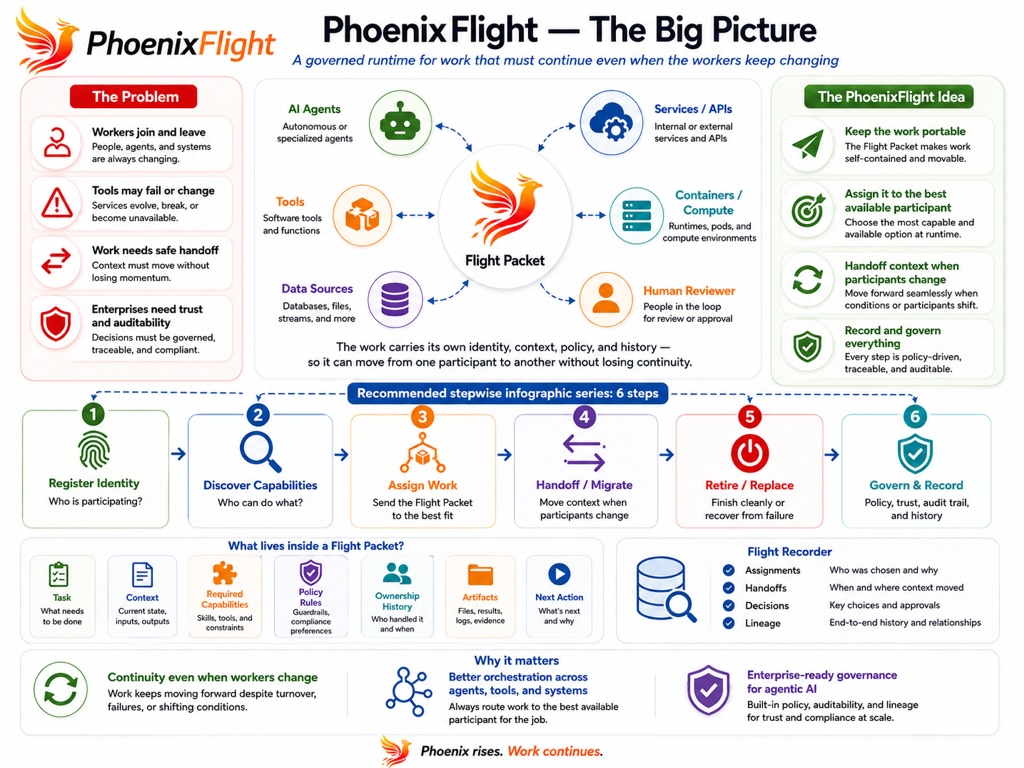
Figure 1. The PhoenixFlight Big Picture overview: mapping dynamic participants, Flight Packets, and the Flight Recorder to the six primitives of the membership lifecycle.
Figure 2. Classic agent workflow vs. dynamic membership runtime
Classic Agent Workflow
- Linear workflow execution
- Local decisions with no cluster awareness
- Limited lifecycle tracking or compliance check
Dynamic Membership Runtime
- Dynamic capability-based routing
- Continuous centralized policy boundaries
- Full lineage and lifecycle auditable trail
Figure 2. A classic agent workflow treats the agent as the center of execution. A dynamic membership runtime treats agents, tools, context, and workloads as governed participants in a lifecycle.
The membership layer as a capability router
We must clarify that the membership layer is not a simple directory service or registration lookup. It functions actively as a governed capability router. When a task payload is submitted, the control coordinator does not just query which nodes are online. It performs a real-time policy evaluation matching task requirements with participant attributes.
This matching routine evaluates the incoming work packet against available node capabilities (supported model type, token window, execution speed), trust parameters (identity signatures, verification key status), policy rules (data residency limits, privacy scopes), and audit guarantees. By evaluating all these conditions simultaneously, the runtime routes work only to nodes that satisfy both execution and compliance needs.
Unlike basic model routers that only distribute queries based on latency or cost, a capability router manages dynamic participation. It actively governs the interaction. If no active participant satisfies the security policies, the router rejects the assignment, ensuring that sensitive workloads cannot be routed to unverified or insecure agents.
Furthermore, the routing decision is not a terminal event. Depending on how execution progresses, the router can initiate context handoffs to other nodes, issue state migration tokens, trigger grace periods for node retirement, or revoke execution leases in response to policy violations.
Definition: Membership Runtime
A membership runtime is a control layer that manages participant identity, discovery, assignment, context handoff, retirement, and auditability.
Figure 3. Membership Layer as Capability Router
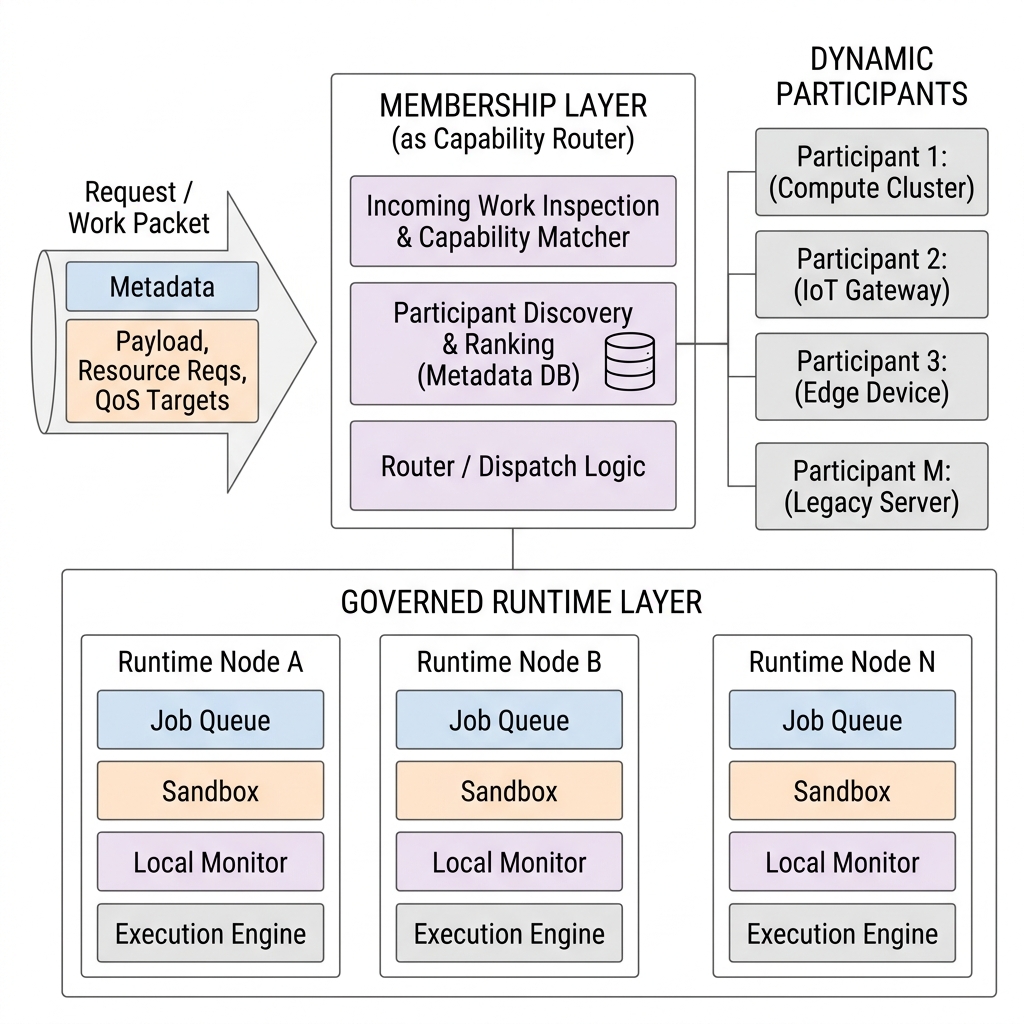
Figure 3. The membership layer routes work by combining capability discovery, policy evaluation, context readiness, and audit requirements.
The membership loop
PhoenixFlight coordinates participant lifecycles using a continuous loop containing six formal primitives: Register, Discover, Assign, Handoff, Retire, and Audit. This structure guarantees that every step of a node's participation in the runtime is verified, bound, and logged.
The loop begins with Register, where the node presents its cryptographic credentials to establish identity. Once authenticated, Discover makes the node's specific capabilities visible to the control plane. When a workload matches these capabilities, the runtime initiates Assign, issuing a task lease.
If execution must migrate, Handoff coordinates context state transfer between nodes securely. Upon task completion, Retire executes graceful node shutdown, clearing local memory. Finally, Audit logs the node's entire transition history, writing signed events to the audit ledger for external compliance reviews.
Figure 4. The Membership Loop
Figure 4. PhoenixFlight frames agentic execution as a governed membership lifecycle rather than an open-ended chain of agent calls.
Why membership matters for agentic AI
Agents are participants, not just functions
Unlike static library files or API function paths, autonomous agents hold active execution loops, query systems, and generate logic. Treating them as first-class runtime participants under a membership model guarantees they remain visible and subject to coordination constraints throughout their lifecycles.
Tools are governed capabilities, not just APIs
When an agent invokes a tool, the runtime must check security boundaries. Instead of allowing open tool access, the membership runtime binds tools as registered capabilities governed by active lease limits and execution rules.
Context is transferable state, not just prompt text
In multi-agent systems, state must migrate across different models. Treating context as a structured, cryptographically validated capsule prevents context drift and ensures receiving nodes inherit verified execution histories.
Retirement is part of correctness
Unused nodes leak memory and credentials. By formalizing retirement as a runtime primitive, the coordinate coordinator flushes session states, commits logs to the ledger, and clean terminates instances, preventing resource leaks.
Auditability is runtime infrastructure
Post-hoc logs are difficult to verify. By treating auditing as an active runtime output, PhoenixFlight records cryptographic signatures at every node transition, creating a tamper-proof lineage ledger.
From model routing to participant governance
To understand why a membership runtime is necessary, we must compare it with existing routing layers. Traditional routing (such as model routers or API gateway tools) focuses entirely on dispatching discrete requests to backend endpoints. They operate on a single request-response loop, ignoring the broader state, lifecycle, and identity of the caller.
| Layer | Main question | Unit of decision | Governance concern | Example output |
|---|---|---|---|---|
| Model Router | Which model should answer? | Model request | Cost, latency, accuracy | selected model response |
| Tool Router | Which tool should be invoked? | API / Tool | Permission, input safety | selected tool call payload |
| Membership Runtime | Which participant may join and act? | Agent / Tool / Workload / Context | Identity, policy, trust, handoff, audit | governed assignment token or denial |
As illustrated, model and tool routers are transactional utilities. They choose endpoint destinations but do not track the caller's operational lifecycle or manage context transitions. They cannot isolate a compromised node or verify state continuity because they lack a membership contract.
PhoenixFlight operates at the membership layer. It establishes a control-plane coordinator that manages node authentication, monitors compliance telemetry during execution, and enforces state handoffs. This ensures that every worker remains bound to governance policies across all lifecycle states.
PhoenixFlight as a reference implementation
PhoenixFlight is an open-source research and reference implementation project associated with PhoenixFlight Labs LLC. It explores how dynamic membership primitives can be represented in a runtime architecture for agentic AI and distributed execution systems.
The reference architecture exposes several functional abstractions to developers:
- Work Packets: Encapsulated job payloads that contain data inputs, execution requirements, policy profiles, and target output locations.
- Participant Registry: A cryptographically verified registry that tracks online workers, their current utilization, trust ratings, and verified capability credentials.
- Policy-Aware Assignment: A scheduling pipeline that maps workloads only to nodes satisfying the required security clearances and privacy constraints.
- Context Handoff: A secure token generation service that packages agent state, prompt variables, and execution histories to allow seamless migrations between nodes.
- Retirement Protocol: A teardown workflow that cleans local node memory caches, terminates daemon threads, and releases network leases.
- Audit Events: An active ledger engine that records state transitions and cryptographic node signatures to maintain compliance records.
What this changes
- Agentic systems become lifecycle systems: Developers transition from managing unstructured script loops to coordinating formal, lifecycle-tracked participants.
- Runtime governance becomes part of execution: Policy checks are moved directly into the coordinate scheduling paths instead of being documented in post-hoc dashboard reports.
- Context handoff becomes state migration for reasoning: State migrations copy active LLM context and reasoning histories, protecting systems from semantic data loss.
- Retirement becomes a correctness primitive: Proper teardown loops eliminate resource leakage, orphaned processes, and credential exposure.
- Auditability becomes a first-class runtime output: Verification records are generated synchronously during node transitions, creating reliable transaction histories.
- Open-source reference implementations make patterns inspectable: Code transparently shows how security protocols operate, allowing the research community to audit logic paths.
By shifting the architectural focus from prompt engineering to system runtime properties, we provide the foundational protocols required to build secure, auditable, and resilient multi-agent clusters.
The runtime is the membership layer. Once AI systems contain dynamic participants, the core runtime question is no longer only where code runs or which model answers. It is who may participate, under what policy, with which context, for how long, and with what audit trail.
FAQ
Q1: What is the membership layer in agentic AI?
A1: The membership layer is the runtime control layer that determines which agents, tools, workloads, models, or context objects can participate in an execution, what they are allowed to do, how context moves, when they retire, and how the system records what happened.
Q2: How is a membership runtime different from a model router?
A2: A model router chooses which model should respond. A membership runtime governs which participants may join and act across the full lifecycle of execution, including identity, discovery, assignment, handoff, retirement, and auditability.
Q3: Why does context handoff matter?
A3: Context handoff preserves reasoning continuity when work moves from one participant to another. Without structured handoff, agentic systems can lose constraints, evidence, tool history, or policy context.
Q4: What is PhoenixFlight?
A4: PhoenixFlight is an open-source research and reference implementation project associated with PhoenixFlight Labs LLC. It explores governed dynamic membership runtime architecture for agentic AI systems and distributed execution.