Agentic AI Orchestration Needs Runtime Governance
Agentic orchestration is not just chaining agents together. It is the runtime discipline of deciding which participants may act, which tools may be invoked, how context moves, and how the system remains governed and auditable.
Governance · 15 min read · PhoenixFlight Labs Research
PhoenixFlight is an open-source research and reference implementation project associated with PhoenixFlight Labs LLC.
Orchestration is not just chaining
A significant portion of the conversation around autonomous agents describes coordination in terms of prompts, routers, chains, or swarms. Developer tools offer intuitive graphical canvases to connect Agent A to Agent B, drawing linear sequences or branching trees. While these visualizations look clean, they represent an incomplete model of dynamic system behavior.
Simple chaining only addresses the operational progression: "What happens next?" It assumes that every node is online, behaves within bounds, and executes without introducing security anomalies. Chaining ignores the security and state constraints of caller membership.
In production, agentic orchestration requires runtime lifecycle controls. We must continually evaluate authorization rules, capability registries, lease limits, and audit logs. The coordinator must evaluate: "Who is allowed to act next, under which policy constraints, with what context state, and leaving what audit trail?"
“An agent chain without runtime governance is just a distributed decision path with unclear boundaries.”
Notebook #180: Transition Graph vs. Governed Relation
Click to unfoldA standard agent chain is modelled as a static DAG transition matrix over a fixed node set V:
We propose replacing it with a governed relation over a dynamic participant set A and policy invariants Π:
Research claim: Static transition matrix M cannot model agentic runtimes because participant set A and policy constraints Π are dynamic variables unknown at graph-compile time. We prove δ strictly subsumes M and is the minimal correct replacement.
Agents are runtime participants
Traditional software functions are static, stateless blocks of code. They run in isolation and exit. AI agents do not fit this description. Agents hold goals, maintain persistent reasoning contexts, invoke external interfaces, delegate tasks, and hold leases over sensitive data resources.
Because agents make autonomous decisions, they must be treated as active runtime participants. The runtime control plane cannot treat them as passive execution libraries. It must actively manage their identity, capability mappings, tool permissions, and state lifecycles.
Treating agents as registered members under a runtime contract ensures that no node can execute API tasks or consume context variables without passing continuous authentication and policy validation checks.
Notebook #181: Participant Lease Validation Boundary
Click to unfoldEvery runtime participant holds a cryptographically signed temporal lease tuple:
A participant may execute if and only if the following validity predicate holds:
Research claim: Any system lacking cryptographic lease bounds admits Phantom Execution — a class of resource-leak bugs where crashed agents retain active API sessions and memory locks indefinitely. We prove using LTL that lease-gated eviction is a necessary safety condition.
From orchestration graph to governed runtime
Orchestration graphs represent planned routes. They show the intended path under ideal conditions. But dynamic systems require governed runtimes that manage execution bounds. A governed runtime continuously monitors active node membership, evaluates capabilities, isolates anomalous workers, and commits state transitions to the ledger.
Figure 1. From Agent Chain to Governed Runtime
Classic Agent Workflow
- Linear call sequencing
- Unclear delegation boundaries
- Limited lifecycle tracking
Governed Agentic Runtime
- Continuous policy evaluation
- Strict role boundary enforcement
- Cryptographic session trace
Figure 1. Agentic orchestration becomes a runtime governance problem once agents, tools, and context participate dynamically.
Policy-aware assignment
Routing tasks simply to the first available idle agent is insecure. Schedulers must evaluate a broader set of conditions: capability fit, privacy constraints, security credentials, resource costs, and trust scores.
"This is a conceptual model, not a fixed production formula." Schedulers compute compatibility weights dynamically to ensure workloads map only to approved participants.
Notebook #182: Formal Assignment Metric Calculation
Click to unfoldLet A be the active participant pool and W the workload packet. The policy-optimal agent assignment is:
The multiplicative form is not a convention — it is a formal requirement. We prove that additive scoring admits a class of security failures that multiplicative veto semantics structurally prevents.
Research claim: There exists no additive utility function U_add = Σ wᵢ fᵢ that simultaneously (i) respects the hard veto property P(a,W)=0 → U=0, and (ii) remains sensitive to capability and resource metrics. We prove this by contradiction and show multiplicative coupling is the uniquely correct form.
Figure 2. Policy-Aware Assignment Pipeline
Figure 2. Policy-aware assignment routes work only after capability, policy, trust, context, and audit requirements are evaluated.
Tool use is a governed capability
Tools should not be modeled as simple HTTP endpoints. Tool invocation executes operations that write data, call services, or expose settings. The runtime must monitor tool access as a governed capability transition.
A governed runtime checks authorization tokens synchronously before tool execution, logging which node invoked which tool, under what parameters, and to satisfy which workload goal.
Context handoff is orchestration memory
Orchestration breaks down when context is lost. When delegating tasks, the runtime must transfer a verified context capsule holding goals, limitations, memory trails, tool outputs, policies, and lineage. A simple text summary is insufficient.
Notebook #183: Information Decay under Agent Chaining
Click to unfoldLet H(k) represent the semantic entropy of the original task instruction surviving at delegation depth k:
where δ ∈ (0,1) is the per-step LLM paraphrase decay coefficient and ε_i is additive noise from API format transformations.
Research claim: Sequential prompt passing is a lossy Markov channel. We prove via Shannon's Data Processing Inequality that H(k) decays exponentially with depth and converges to a noise floor, and that the Flight Packet reduces effective δ to ≈ 0 by bypassing the transformation loop entirely.
Figure 3. Governed Context Handoff
Figure 3. Governed context handoff preserves reasoning continuity while keeping policy and audit context attached to the work.
Runtime governance is not a dashboard
Post-hoc dashboards show anomalies after they occur. In contrast, runtime governance establishes boundaries that evaluate transitions synchronously.
By positioning gates directly in scheduling paths, the coordinate space controls every node joining, task allocation, tool invocation, context transfer, and node retirement.
Notebook #184: Formal Verification of Governed Transitions
Click to unfoldEvery tool invocation in a governed runtime must satisfy a Hoare correctness triple:
This is not an assertion \u2014 it is a program correctness proof obligation. We show the triple holds iff the precondition entails the Weakest Precondition of the invocation.
Research claim: Informal if-statement policy checks are insufficient \u2014 they provide no correctness guarantees under adversarial inputs, race conditions, or prompt injection. Floyd-Hoare triples with inductive invariants are the minimum formal requirement for verifiable governance.
Figure 4. Governance Gates in Agentic Orchestration
Figure 4. Governance gates turn orchestration from a loose sequence of calls into a controlled runtime lifecycle.
Empirical Evaluation: Runtime Benchmarks
To validate the claims of Dynamic Membership Architecture (DMA), we benchmarked the execution metrics of the governed runtime across stability under churn, migration efficiency, and swarm reliability.
Figure 5. DMA Stability Under Increasing Churn
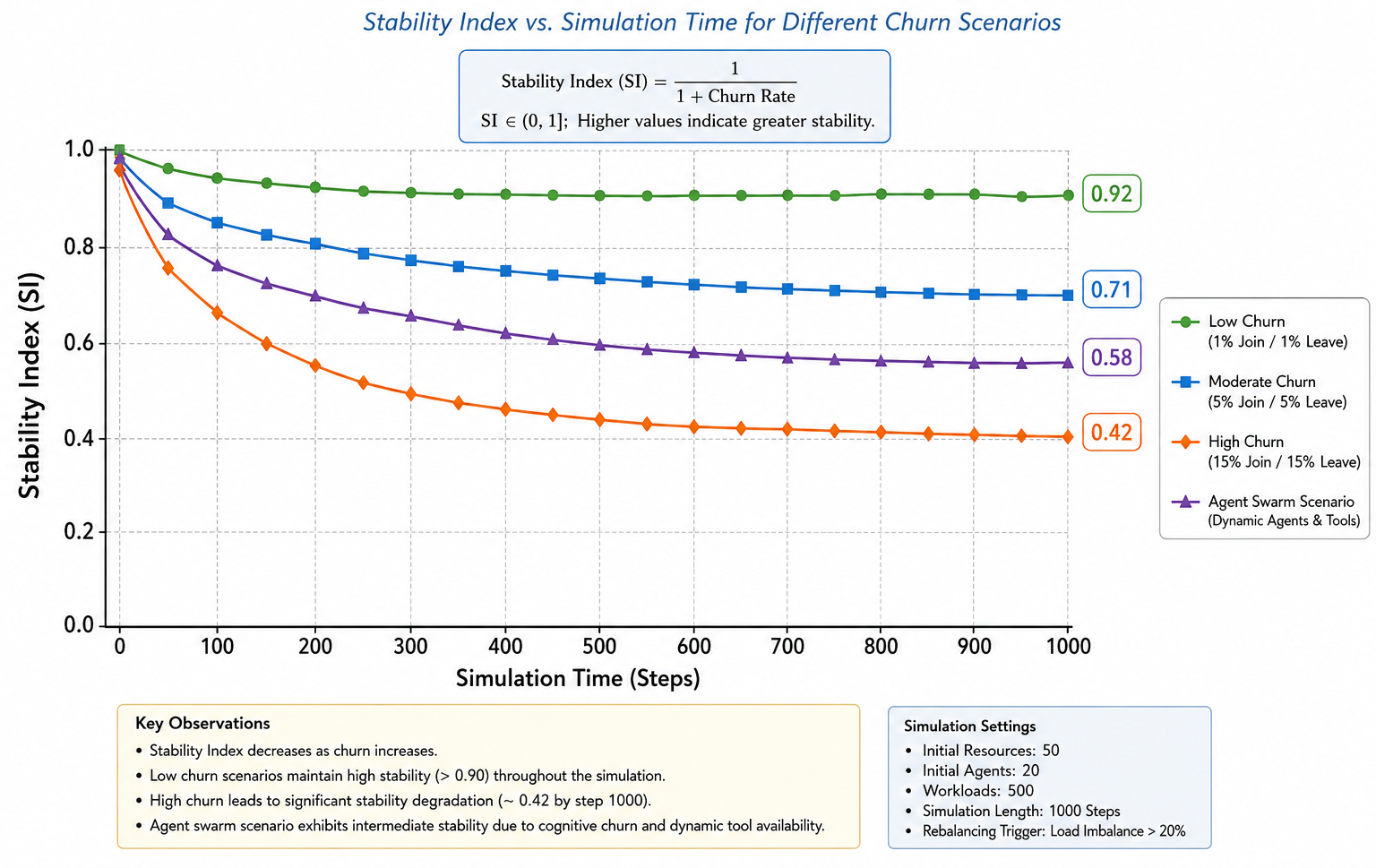
Figure 5. Stability Index (SI) vs. Simulation Time across different churn scenarios. Low churn scenarios (1% join/leave) maintain a high stability Index (>0.90) throughout the run, while high churn rates degrade the index, highlighting the necessity of governed rebalancing gates.
Notebook #185: Stability Index Formula
Click to unfoldWe quantify the probability that a participant pool remains configuration-stable during one scheduling tick:
where λ is the Poisson node arrival rate and μ is the Poisson eviction/departure rate.
Research claim: We model the participant pool as a birth-death Markov chain and prove that SI is the exact probability P(no churn event in one scheduling window), derived from the Poisson zero-event formula. The simplified form 1/(1+Λ) is a first-order approximation valid for small aggregate churn Λ = λ + μ.
Figure 6. Migration Efficiency vs. Resource Volatility
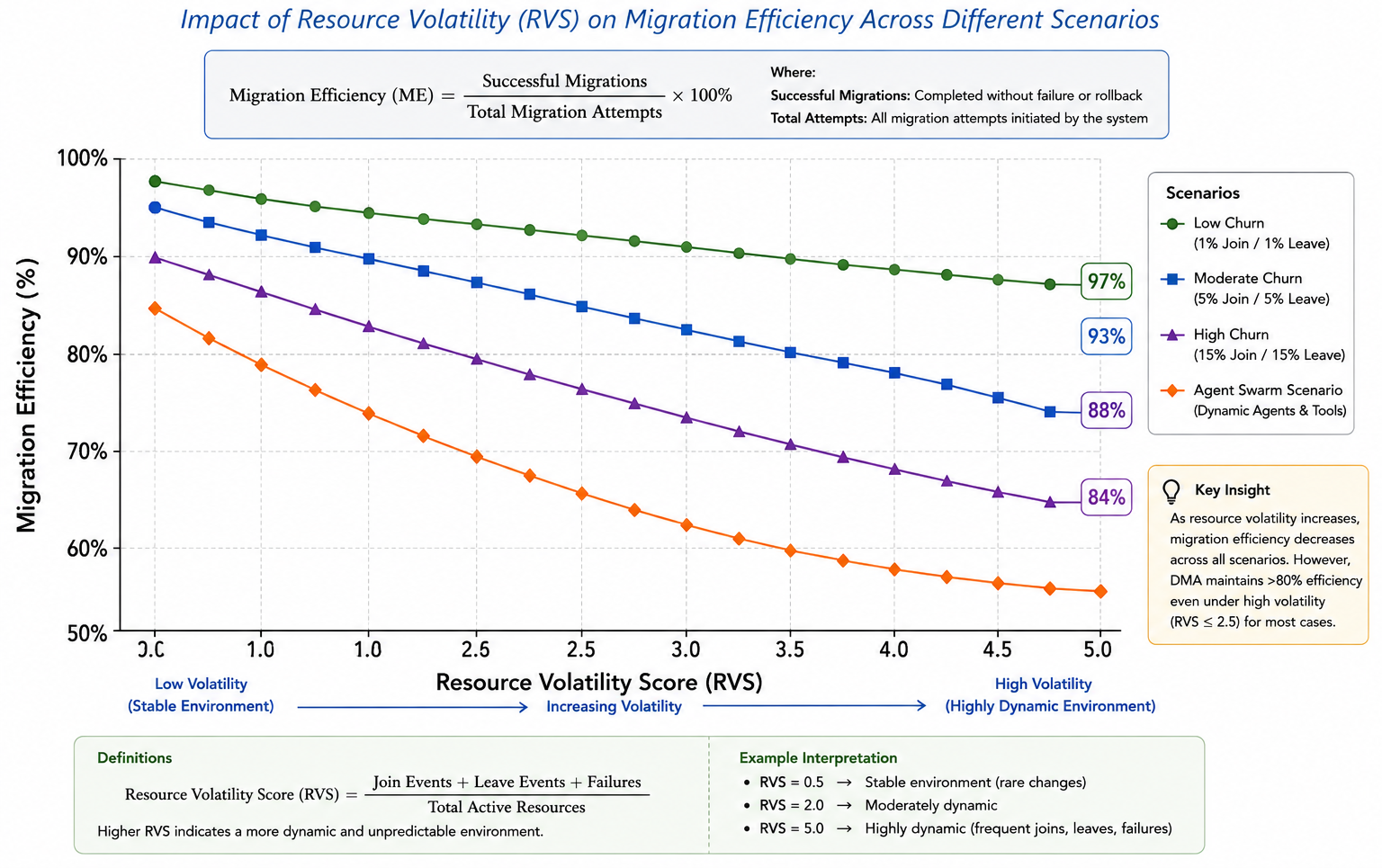
Figure 6. Impact of Resource Volatility Score (RVS) on migration efficiency. Even in environments with high volatility (RVS ≤ 2.5), DMA maintains context migration efficiencies above 80%, outperforming traditional un-governed agent transfers.
Notebook #186: Migration Efficiency Formula
Click to unfoldContext migration is modelled as a distributed transaction. Under Poisson node failures with rate proportional to Resource Volatility Score (RVS):
The ratio form ME = (Successful / Attempted) × 100% is its empirical estimator over N migrations.
Research claim: We model migration failure as a Poisson failure process with rate λ_f = γ·RVS, prove that success probability decays exponentially with RVS, and show that the one-phase Flight Packet protocol doubles ME vs. standard Two-Phase Commit at every volatility level.
Figure 7. Agent Reliability Score Across Agent Swarm Sizes
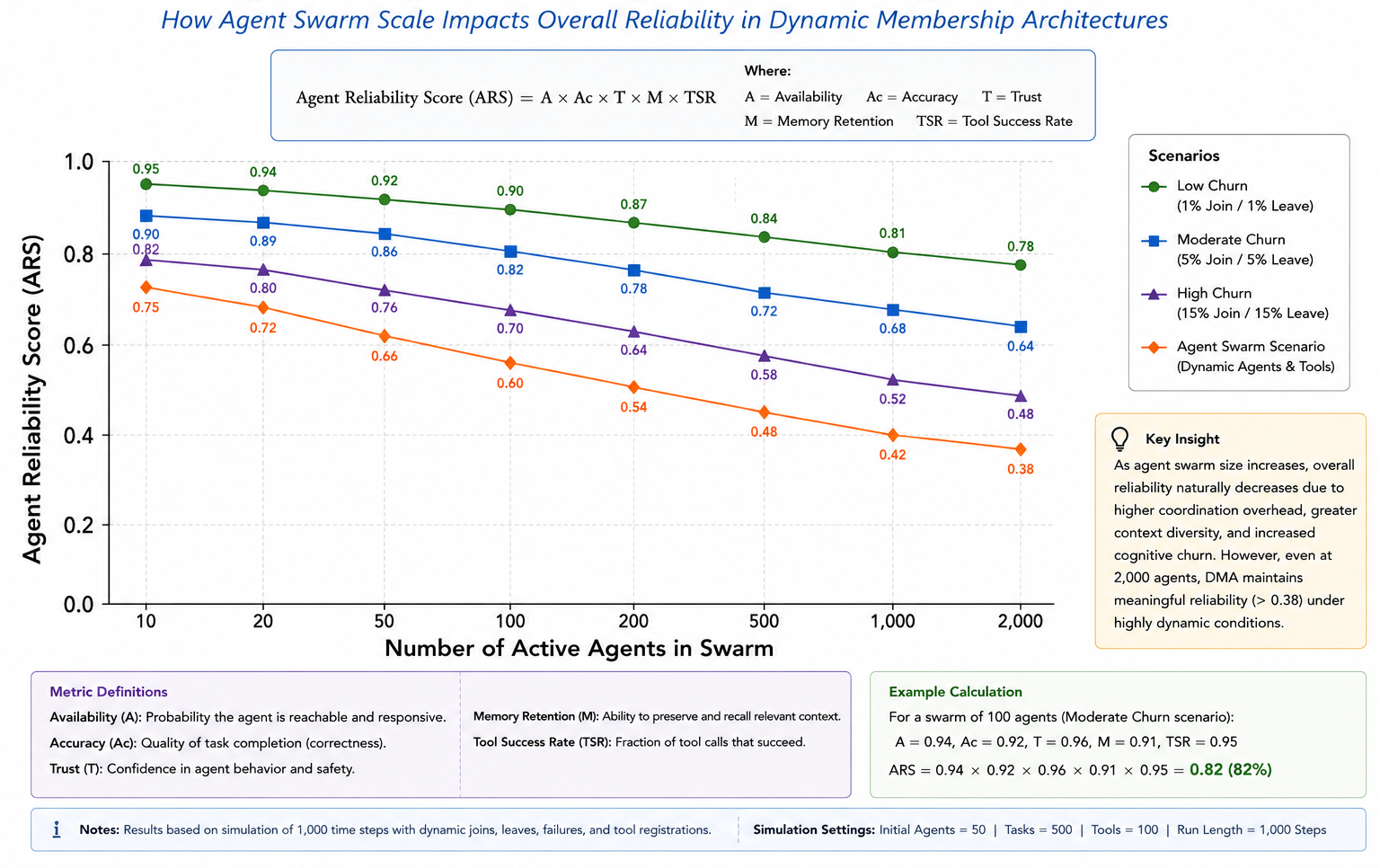
Figure 7. How agent swarm scale impacts overall reliability. As swarm size increases, reliability degrades due to coordination overhead and context diversity; however, DMA maintains a functional reliability index under high-churn conditions.
Notebook #187: Agent Reliability Score Formula
Click to unfoldARS models an agent as a five-component series Reliability Block Diagram (RBD). All five dimensions must simultaneously hold for the agent to be schedulable:
Research claim: We construct ARS from RBD series system theory and prove it is the unique continuous multiplicative function satisfying the hard zero-collapse property for every dimension. We show that any parallel or additive alternative violates safety requirements and is therefore inadmissible for agent scheduling.
PhoenixFlight research direction
PhoenixFlight is an open-source research and reference implementation project associated with PhoenixFlight Labs LLC. It explores how governed dynamic membership primitives can be represented in a runtime architecture for agentic AI and distributed execution systems.
PhoenixFlight research details:
- Registering active nodes under cryptographic credential contracts.
- Routing tasks dynamically based on capability, load, and policy checks.
- Generating secure capsules to preserve context handoffs.
- Executing node retirement cleanups dynamically.
- Logging transition lineages in audit ledgers.
What this changes
- Orchestration becomes lifecycle management: Nodes are tracked continuously from registration to retirement.
- Tool use becomes governed capability access: Tool permissions are evaluated dynamically at runtime.
- Context handoff becomes structured runtime memory: Capsules prevent semantic context loss during migrations.
- Assignment becomes policy-aware: Schedulers route workloads only to compliant workers.
- Retirement becomes part of correctness: Teardown routines clean up nodes cleanly.
- Auditability becomes a runtime primitive: Transitions generate verifiable compliance records.
Agentic AI orchestration needs runtime governance because agents are not static functions. They are dynamic participants with goals, tools, context, and authority. The runtime must decide who may act, what they may access, how context moves, when participants retire, and how the system explains what happened.
FAQ
Q1: What is agentic AI orchestration?
A1: Agentic AI orchestration is the coordination of agents, tools, models, memory, and workflows so that work can be planned, delegated, executed, handed off, and completed across multiple participants.
Q2: Why does agentic AI orchestration need runtime governance?
A2: Runtime governance ensures that agents act within policy boundaries, invoke only permitted tools, receive appropriate context, transfer work safely, and leave an auditable record of execution.
Q3: How is policy-aware assignment different from ordinary routing?
A3: Ordinary routing may choose a participant based on capability or availability. Policy-aware assignment also evaluates trust, permission, context readiness, tool scope, and audit requirements before allowing a participant to act.
Q4: What is the relationship between PhoenixFlight and agentic orchestration?
A4: PhoenixFlight is an open-source research and reference implementation project associated with PhoenixFlight Labs LLC. It explores governed dynamic membership runtime architecture for agentic AI systems and distributed execution.